


For graduates seeking a career that combines strategy, problem-solving, business impact, and rapid professional growth, consulting has historically been one of the most sought-after paths. Firms such as McKinsey, Bain, and BCG have attracted ambitious graduates with the promise of challenging work, prestigious brands, and accelerated development.
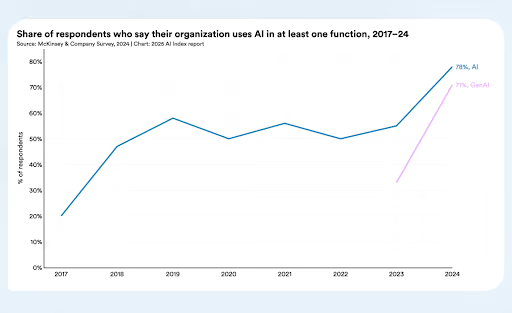
But the work itself is changing. In 2024, the share of organizations using AI jumped to 78%, up from 55% the year before, and the number reporting generative AI use in at least one business function more than doubled, from 33% in 2023 to 71%1. AI is rapidly transforming how knowledge work is performed and the tasks that once defined the early years of a consulting career (researching markets, synthesizing information, analyzing data, building models, developing presentations) are exactly the ones increasingly enhanced or automated by these tools.
Consulting remains a valuable career path. But it raises a new question for today's graduates:
Which career path will best develop the skills that become more valuable as AI transforms the workplace?
For many new graduates, executive search deserves a closer look.
Often misunderstood as simply recruiting, executive search is a strategic advisory profession focused on helping organizations identify, evaluate, and hire leaders during critical moments of growth, transformation, and change.
Executive search professionals work with founders, boards, investors, and senior executives to answer one of the most consequential questions facing any organization:
Who is the best leader capable of shaping the company’s future at this pivotal moment?
Unlike traditional recruiting, high-level executive search requires a combination of analytical thinking, business acumen, leadership assessment, relationship-building, and human judgment. These capabilities matter more as AI automates more routine analytical work.
What follows is a direct comparison of how each path builds strategic thinking, leadership exposure, decision-making skill, and long-term career capital, so graduates can choose the one built for the AI era, not the one built for the last decade.
Executive Search vs. Consulting: What’s the Difference?
At first glance, consulting and executive search attract similar people. Both value intellectual curiosity, structured problem-solving, strong communication skills, and the ability to build trusted client relationships. It’s no coincidence that many executive search professionals previously worked in consulting.
The difference lies in the type of problems each profession solves.
Consultants help organizations answer strategic business questions. They analyze data, identify opportunities, and recommend solutions that improve performance or address complex challenges. Their work influences decisions, but clients ultimately determine what actions to take.
Executive search professionals solve a different problem: Who is the right person to lead the organization?
Rather than recommending strategies, they help companies identify, evaluate, and recruit CEOs, executives, and board members whose decisions will shape an organization’s future.
The work requires rigorous analysis, but it also depends on qualities that are difficult to automate, including judgment, emotional intelligence, and the ability to assess leadership potential in uncertain situations.
In today’s business environment, where AI is accelerating analytical work, that combination of human insight and strategic thinking only grows more valuable.
Executive search blends several disciplines that rarely sit together in one role:
- Analytical rigor, to assess candidates and organizational needs with precision.
- Applied psychology, to understand motivation, blind spots, and how a leader will actually behave under pressure.
- Pattern recognition, built across hundreds of companies and leadership situations.
- Relationship and trust-building, with founders, boards, and investors who do not extend trust easily.
The distinction that matters most is that a consultant typically recommends a course of action and leaves the client to decide whether to act. An executive search professional directly changes the outcome by determining who gets placed in a role that will shape the company for years. The recommendation and the result are the same act.
Why Should a New Graduate Consider Executive Search Over Consulting?
The instinct for an ambitious graduate is to start in consulting because it’s where the analytical training and prestige are. But executive search uses that same analytical rigor while adding something consulting increasingly cannot offer: direct, repeated practice in high-stakes human judgment, starting early. It rewards structured thinking, client fluency, and pattern recognition, which is exactly why elite search firms deliberately recruit from McKinsey, Bain, and BCG. In an economy where AI handles routine analysis, the human judgment at the center of search work is becoming more valuable, not less. Starting there directly means you begin building that scarce skill from day one, instead of spending your first years developing analytical skills that AI is rapidly commoditizing.
Several forces are making this path more logical for new grads than it used to be.
AI Is Automating the Analytical Apprenticeship
The model-building, deck production, and data synthesis that once filled a consultant’s early years and quietly built judgment through repetition are increasingly automated. The output still gets produced faster than before, but the learning that used to be embedded in that work is disappearing. Consultants who want to keep developing their judgment, rather than becoming operators of AI tools, look for environments such as executive search that still require it.
Consulting’s Economics Are Shifting
The industry is moving from billing for hours to billing for outcomes. When compensation is tied to results rather than effort, speed and precise judgment stop being nice-to-haves and become the core of the value delivered. That raises the premium on exactly the human skills executive search is built around.
Executive Search Offers Proximity to Real Decisions
Many consultants grow frustrated producing analysis that clients may or may not implement. Executive search places them in the room where founders and boards make the decisions that determine a company’s trajectory with a direct hand in the outcome.
The Skills Transfer Cleanly
Structured problem-solving, client management, synthesis, and intellectual rigor, the core of consulting training, are precisely what high-level executive search demands. This is not a career reset. It is a redeployment of the same toolkit toward higher-judgment work.
Demand for Search Talent Is Growing Fast
At Occam, we’re watching two shifts that are driving demand for skilled executive search professionals, especially in our core areas of expertise: life sciences and AI-native deep tech companies.
First, technology venture capital firms are moving into life sciences. Investors who built their track records in software and consumer tech are now deploying serious capital into biotech, health tech, and adjacent fields, drawn by the pace of scientific breakthroughs and the scale of the problems. That capital needs the right leadership behind it, and placing executives at the intersection of deep science and high-growth company-building is exactly the kind of high-judgment work that defines search at its best.
Second, AI-native companies are scaling fast. A new generation of firms is being built with AI at the center from day one, and they’re growing into their org charts at speed. That growth creates constant demand for leaders, founders, operators, and boards who can steer companies through hypergrowth, and for the search professionals who identify and assess them.
Both trends point in the same direction: more companies at critical inflection points, more leadership decisions that determine their success, and a growing need for people who can do this work at a high level. The demand for genuine executive search expertise is expanding, and the supply of people trained to meet it through real apprenticeship rather than automated shortcuts is not keeping pace. That gap is an opportunity for the right people entering the field now.
The Egon Zehnder Precedent: Search Firms Already Recruit the Best Analytical Talent
This is not a novel or fringe path. A Harvard Business School case study on Egon Zehnder, one of the most respected executive search firms in the world, documents a deliberate strategy of recruiting talent from elite consultancies rather than growing generalist recruiters. That talent arrives with structured thinking, client orientation, and analytical discipline already in place. By the late 1990s, roughly one in five of the firm’s consultants had come from McKinsey.
The implication is worth stating plainly for a new grad: the most prestigious names in consulting have functioned, in practice, as feeders for top-tier executive search, because the smartest people in the field recognized that search work demands everything consulting teaches, plus something consulting cannot reliably provide. The talent flow that most graduates assume runs in one direction has, at the top of the field, been running the other way for decades. Knowing that now means you can aim directly for the destination instead of taking the long way around.
How Executive Search Builds “Irreplaceable” Judgment
Judgment is the ability to make sound decisions in ambiguous situations, weighing tradeoffs, personalities, histories, and possible futures with no clean answer key. It is the capability AI is furthest from replicating, because it depends on trust, context, values, and relationships rather than pattern-matching alone. Here is how a high-level search career develops it.
1. Apprenticeship, Not Instruction
You cannot learn judgment from a textbook, a course, or a tool. You develop it by watching skilled practitioners navigate real ambiguity, seeing how they recover from mistakes in real time, and absorbing the tacit knowledge that never makes it into a book. The best search firms run on a genuine apprenticeship model: junior professionals work alongside senior practitioners who share their reasoning openly, not just their conclusions. This is the kind of mentorship that flattened, AI-heavy organizations rarely offer anymore.
2. Writing as a Thinking Discipline
One of the most distinctive features of high-level search work is a culture of writing. Where many environments reward verbal fluency and slide production, top search firms demand a clear, defensible point of view in prose. Every major situation gets a written synthesis that forces the professional to take a position, not just present options.
The reason is practical: writing exposes gaps in reasoning that conversation conceals. You can say something half-formed and move past it; you cannot write it without seeing the hole on the page. Over time, the habit of writing before speaking trains a person to form, defend, and refine judgment under pressure. It is also why offloading this work to AI is counterproductive; it removes the very exercise that builds the skill.
3. Accumulated Pattern Recognition
Exposure to many companies at similar stages, facing similar problems, builds a personal archive that no AI model can fully replicate: what worked in prior situations, which leadership profiles thrived or failed, how particular stakeholder dynamics tend to resolve. Executive search practitioners bring this lived, comparative history into every new client scenario.
4. Real Relationship and Trust Capital
Much of the work is building genuine trust with founders, often technically brilliant but unsure how to hire, and with the boards and investors around them. A significant share of the job is strategic counsel rather than recruiting: helping clients understand what a strong candidate actually looks like, what is realistic versus wishful thinking, and how to weigh a proven track record against raw potential. These are human capabilities that cannot be fully automated.
Consulting vs. Executive Search: A Direct Comparison
Both are demanding, intellectually serious careers. The comparison is not about prestige but about where a given kind of skill gets built and which of those skills is becoming scarcer.
The Bigger Picture: The Judgment Deficit
There is a structural reason this matters beyond any individual career choice. As AI becomes embedded in knowledge work, many entry-level professionals are outsourcing the cognitive struggle that used to be part of building expertise. The output looks polished, but the underlying judgment never develops. The result is a widening gap between a small group of senior leaders with decades of hard-won pattern recognition and a large pool of capable professionals who never got the apprenticeship that would have closed it.
The careers that remain most valuable in this environment are the ones that still require and deliberately build human judgment. High-level executive search is one of the clearest examples: a field where the core work cannot be automated, where judgment is developed through genuine apprenticeship, and where a consultant’s existing skills transfer directly into higher-judgment work.
Is an Executive Search Career a Good Fit for You?
Based on the profiles who tend to thrive in the field, executive search suits new graduates who:
- Have strong analytical training.
- Are genuinely curious about people, what drives them, how they make decisions, and why they succeed or fail.
- Want proximity to real outcomes rather than producing analysis that may not be implemented.
- Value mentorship and the deliberate development of judgment over accumulating prestige credentials.
- Can write clearly and are willing to take defensible positions rather than hedge.
- Are ambitious about responsibility and impact, not only titles.
What you can expect to earn: Compensation grows significantly with experience in deep tech and life sciences stand out as particularly lucrative sectors. Associates typically start with base salaries of roughly $55,000-$90,000; once bonuses are factored in, total compensation at prominent firms averages around $140,000, with room to climb into the mid-$250,000s as you take on higher-level searches.
If most of that describes you, executive search is worth a serious investigation before you default to signing a consulting offer.
Ready to learn more? Follow Occam on LinkedIn for the latest trends in executive search, or reach out to our team to talk about what a career in search could look like for you.
Considering a career in executive search?
Reach out to us at info@occam-globlal.com to learn more.